
Our history
In 1960 a Sherpa leader asked for a school for his village's children, and the Himalayan Trust grew from it. More than sixty years on, it is one of the longest-running development partnerships in the world. This is how it happened.
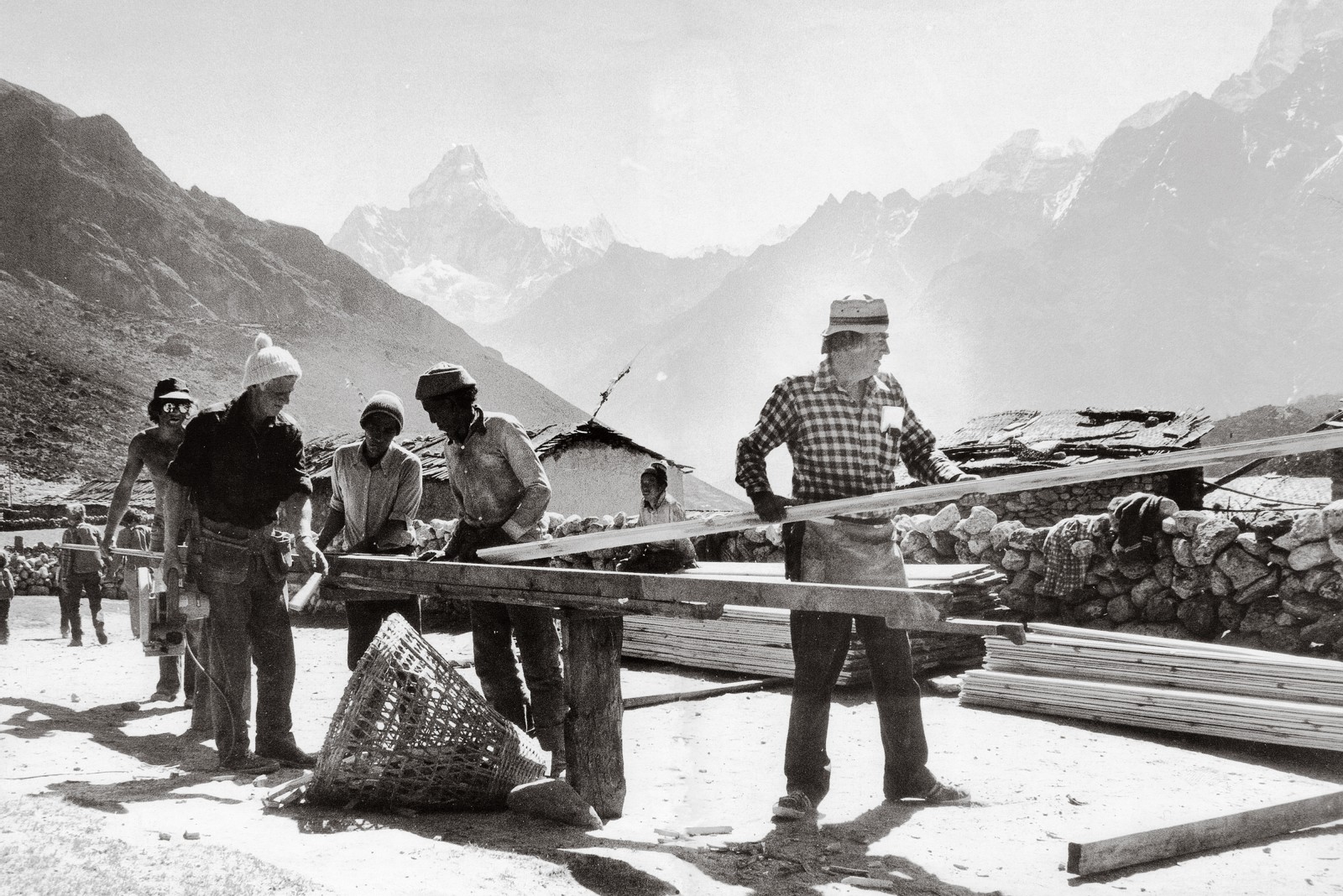
The Trust began with a school. Communities have kept asking for help since, and we have kept saying yes.
In 1960, Sir Edmund Hillary asked Sherpa leader Urkien what his village needed. The answer was a school. Eight months later, Khumjung School opened. Then came another school, and another. Hospitals. Bridges. Water systems. Sixty years later, we're still here, not because we planned to be, but because communities kept asking and we kept saying yes.
This page tells that story. Not as a timeline of achievements, but as a record of partnership.
Decade by decade
1960s
The beginning
A school was the first thing the village asked for, and it was open eight months later. By the end of the decade, Hillary had built schools in Khumjung, Pangboche, Thame, Tengboche, and Phortse. Lukla airstrip opened up the region. Khunde Hospital became the first in the Khumbu. Bridges spanned the Dudh Koshi and Bhote Koshi rivers. The partnership model was set: ask, listen, build together, stay.
1970s
Expansion
The work expanded into Solu. In 1975, tragedy struck when Louise and Belinda Hillary died in a plane crash. Hillary finished building Phaplu Hospital anyway, in 1975. Sagarmatha National Park was established with HT support, protecting the region while allowing Sherpas to continue their way of life. More schools, more clinics, more water systems.
1980s
Deepening
Primary schools became high schools. Teacher training was formalised. The first generation of HT-educated students graduated and began working in their communities. Then, in January 1989, fire destroyed Tengboche Monastery. Hillary, now 69, promised the Rinpoche: "It will be rebuilt."
1990s
Rebuilding
Four years of work restored Tengboche. Skilled local craftsmen and artists used traditional methods. The monastery reopened in September 1993. Hillary was there. Meanwhile, new clinics opened and water systems expanded across both Khumbu and Solu. The work continued.
2000s
Transition
Sir Edmund Hillary died in January 2008. New Zealand gave him a state funeral, the first non-political figure to receive one. Peter Hillary continued his father's work. In Nepal, a new generation of Sherpa leaders, many educated in HT schools, took on greater responsibility. The partnership evolved but the approach remained.
2010s
Resilience
The 2015 earthquakes damaged most Khumbu schools. It was our largest test. Over three years, we rebuilt 150 earthquake-strengthened classrooms across 36 schools, the biggest infrastructure project in our history. The Lukla water system was completed in 2014, serving 3,000+ people. In 2019, we finished the Musey water project.
2020s
Innovating
New projects. Same approach. Three generations of Hillary family leadership. Three generations of Sherpa partnership. The communities we've worked with for 60 years still ask us for help, and we still say yes.