
Lukla Airstrip
Project details
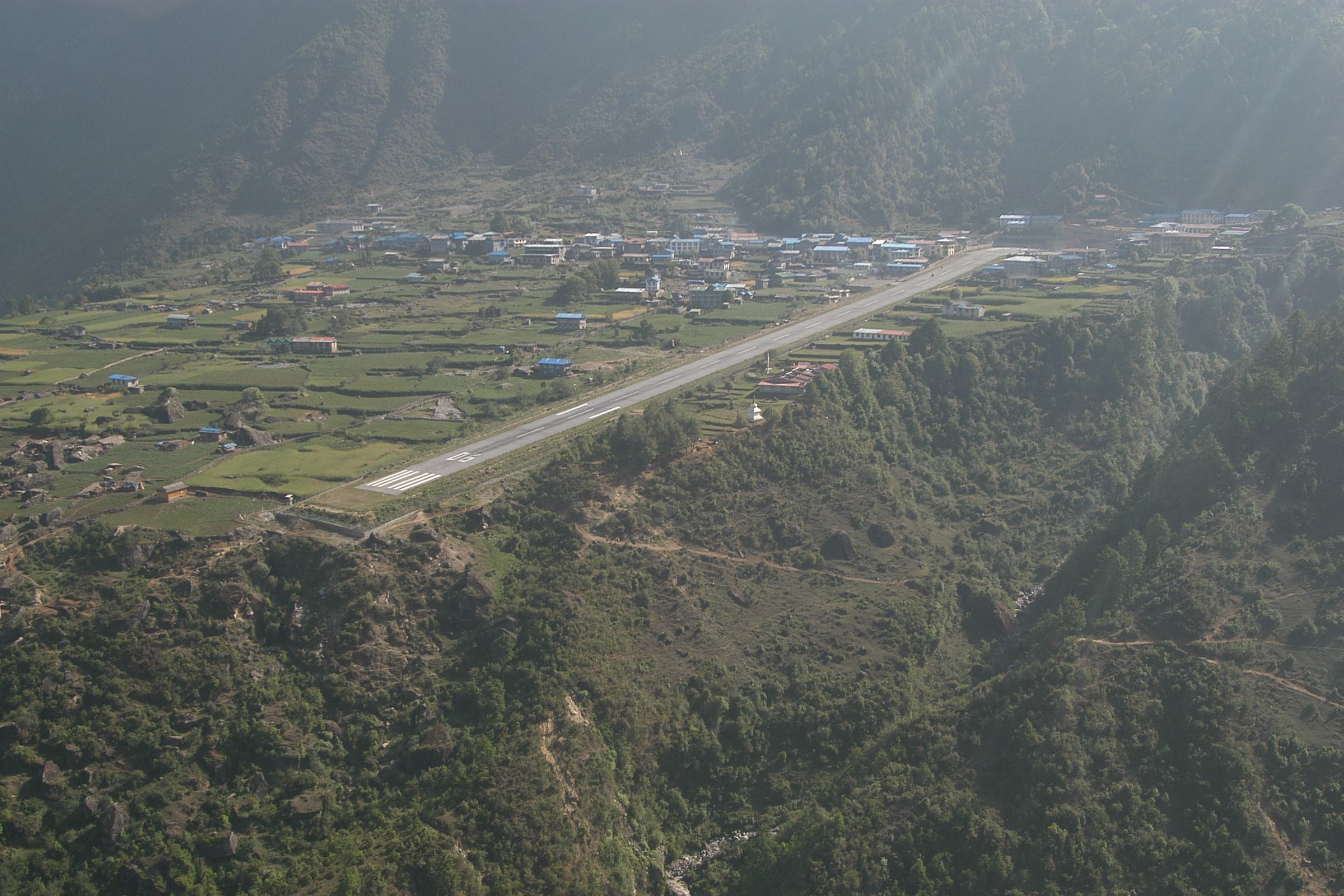
In 1964, Sir Edmund Hillary needed a way to fly building materials in for the hospital he was planning at Khunde, since porter trains from Kathmandu took seventeen days. His first choice of site, at Chaurikharka, turned out to be too broken and short. Farmers from the nearby village of Lukla then offered their own land instead, on a steep slope higher up the valley. Hillary's expedition and about 110 local Sherpas built the airstrip that year, flattening terraces and stamping the surface hard by dancing on it.
Four weeks after work began, Swiss pilot Emil Wick landed the first plane, a Pilatus Porter, on the new strip. Hillary expected Lukla to stay a quiet dirt strip used for the occasional aid flight. Instead it became the second busiest airport in Nepal, and today it is the gateway that tens of thousands of trekkers fly through each year on their way towards Everest. In the mid-1970s Hillary wrote that he was sometimes "racked by a sense of guilt" about how much the airstrip had changed the region.
When Sir Edmund Hillary set out in 1964 to find a site for an airstrip, his aim was narrow and practical. He needed a way to fly building materials in for the hospital he was determined to build at Khunde two years later, because porter trains from Kathmandu took seventeen days and were, in his own words, "just too cumbersome." He had already tried once and failed, closing a dangerous strip at Mingbo that he later called his "kamikaze landing strip." This time he sent his climbing friend Jim Wilson, Sherpa sardar Mingma Tsering and the Antarctic geologist Bernie Gunn to survey a site at Chaurikharka. It proved too broken, too short and too exposed to cross-winds.
A delegation of farmers from the village of Lukla, higher up the valley, then made their own case. "We have a good place for aeroplanes to come to," they told the surveyors. "It is quite long and there is never much wind." The site was a scatter of houses and terraced potato fields, far from flat, but when Bernie Gunn measured it there was room for a 400-metre strip. The six landowners sold their land to the Government of Nepal for the equivalent of $835. Hillary's expedition and 110 local Sherpas built the strip that autumn, flattening terrace walls, rolling boulders aside and stamping the surface hard underfoot until it would hold an aircraft.
Four weeks after work began, Swiss pilot Emil Wick brought a Pilatus Porter in for the first landing. He described the difficulty of it afterwards: "Come in too low and you hit the end of the runway and you die. Come in too high with a heavy load of passengers and you find yourself with the options of trying to pull out or maybe hitting the wall at the top of the strip." It remains, decades later, one of the strips regularly named the world's most dangerous airport.
Hillary expected the strip to stay a quiet dirt runway for aid flights and the odd expedition. Instead it reshaped the whole region. In early 1967, the Trust's own doctor at Khunde, John McKinnon, heard a rumour that the strip might be closed as too short and extended it on his own initiative, without waiting for Hillary's reply to two letters. Hillary was alarmed at the cost, but was impressed once he saw the finished work. Trekking numbers, fewer than a hundred a year through the 1960s, grew into the tens of thousands: by 2016 more than 40,000 people a year were entering Sagarmatha National Park, most of them flying into Lukla. In the mid-1970s Hillary wrote that he was sometimes "racked by a sense of guilt" about how much his small airstrip had changed a valley that had once grown potatoes.