Menstrual Health Solukhumbu
Project details
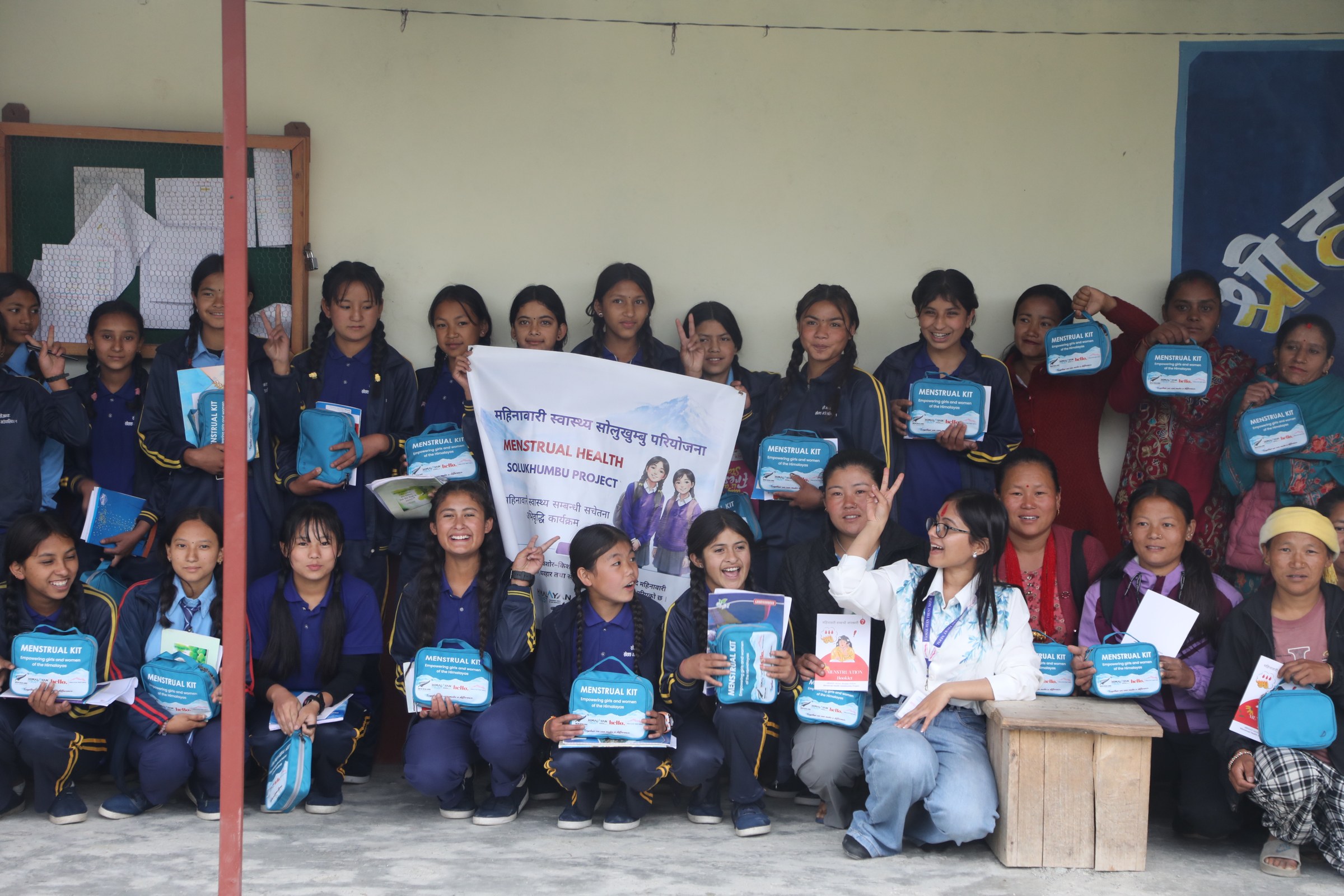
Menstrual Health Solukhumbu is the second phase of a Himalayan Trust Nepal programme that began as a pilot in three schools in 2025. Funded by Himalayan Trust New Zealand and the New Zealand High Commission, with menstrual products now supplied by a new partner, Hello Period, the 2026 phase runs across eight Solukhumbu schools, including Khumjung Secondary School, all supported under the Trust's Centres of Excellence programme. A baseline survey of 182 girls and 200 women ran across the eight schools in February and March 2026.
That baseline found how differently menstruation is still treated from village to village: one Khumjung woman said her family follows no restrictions at all, while a woman in Hulu described being barred from her own house for seven days during her first period, unable to see her home's roof or her brother's face. Forty percent of girls knew little about menstruation before their first period, and nearly one in five had missed school because of it. Sessions and product distribution are rolling out through 2026.
Phase two scaled up quickly. Where the 2025 pilot reached three schools and 246 people, the 2026 baseline survey alone reached 182 girls and 200 women across eight schools, chosen because they already sit inside Himalayan Trust's Centres of Excellence network. The eight are Junbesi, Taksindu, Mahendra Jyoti, Janasewa, Juving, Hulu, Chandra Jyoti and Khumjung Secondary Schools, spread across five rural municipalities.
Binita Tamang, a Grade 8 student from Lokhim boarding at the Junbesi school hostel, got her first period at 14 with no idea what was happening to her. Frightened, she eventually told the older girls in her hostel, who helped her through it. The nearest shop selling pads is about an hour's walk away and often more than she can afford, so she has mostly managed with cloth instead, and she asked for the programme's support to keep reaching communities like hers.
The baseline also measured how much distance still needs to be covered: 81.5 percent of the 200 women surveyed had never heard of a menstrual cup or disc, even though most said, once shown, that they wanted to learn. Field implementation, including product distribution and follow-up training, is running through the rest of 2026, and Himalayan Trust plans to report the results in 2027.