
Salleri High School
Project details
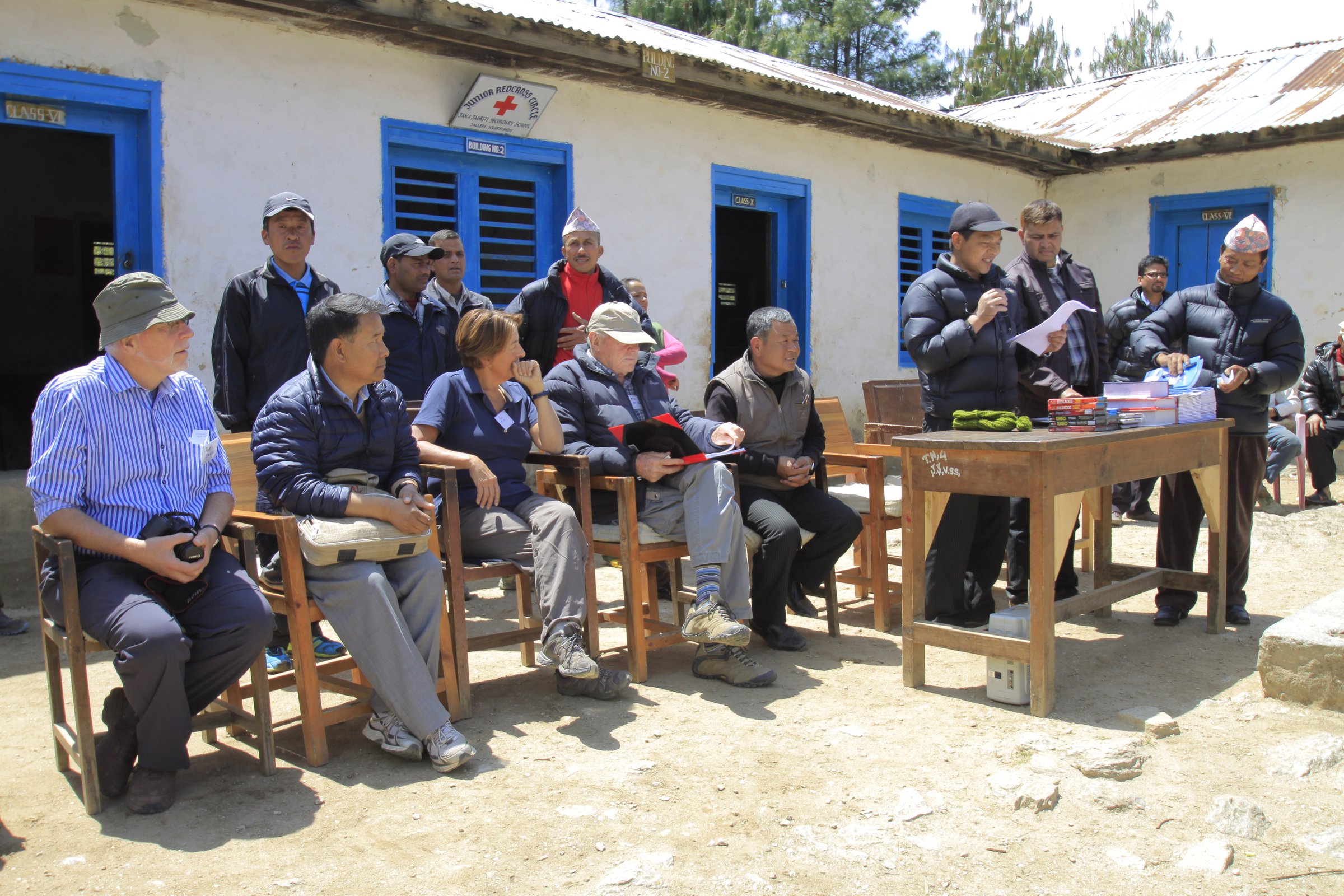
Sir Edmund Hillary's Himalayan Trust helped build a high school in Salleri around 1973, the administrative centre of the wider Solukhumbu district. Salleri sits in Solu, the lower part of the district, away from the higher Khumbu villages the Trust's earlier schools had served. Now called Janajagriti Secondary School, it has grown into one of the largest schools the Trust supports, with around 550 students and a computer lab installed in 2018.
Two of its early scholarship students went on to lead the Trust's own hospitals for decades. Mingmar Gyelzen, described in a 1972 letter as wanting to become the first Sherpa doctor, studied at Salleri before training in India, then ran Phaplu Hospital from 1982 to 2007, turning it into what was recognised as the best hospital in Nepal's hill regions. Kami Temba, who boarded at Salleri for three years living on 150 rupees a month, later trained in Fiji and became Khunde Hospital's long-serving doctor in charge.
Two of the Himalayan Trust's most important Sherpa staff both passed through Salleri's classrooms. Mingmar Gyelzen first appears in Trust records in a 1972 letter from a British diplomat who had met him on the trail to Jiri: a "good-looking and intelligent Sherpa youth," educated at Salleri High School, who had gone on to become the first Sherpa admitted to Amrit Science College in Kathmandu, and whose ambition was to become the first Sherpa doctor. His parents had paid for his schooling "at considerable sacrifice" but could not stretch to medical school. He found his own way there instead, winning a scholarship to a college in India and qualifying as a doctor in 1978.
Gyelzen made the first-ever application by a Sherpa doctor for the post at the Trust's new hospital in Phaplu, in 1981, and ran it from 1982 to 2007. He organised family planning, immunisation and eye camps across the whole of Solukhumbu, opened new health posts, trained health workers and started a nursing school, and was awarded Nepal's King's Medal in 1986. By the 1990s, Phaplu was widely recognised as the best hospital in the hill regions of Nepal. When Gyelzen finally moved to Kathmandu in 2007 to take a senior post in the national health service, Sir Edmund Hillary, who had always admired him, ended the Trust's remaining ties with him. Gyelzen wrote back that whatever Solukhumbu's Sherpas had achieved, they owed to the Trust.
Kami Temba's route to Salleri was harder still. His father died before he was born, and without the Trust's schools he would have grown up herding his family's yaks at Thame. He walked five hours each way to attend Khumjung School once Thame's own school ran out at Class 4, sometimes falling asleep during the lunch break after all-night village festivals. After Class 7 he and his closest school friend, Ang Gyelzen, won Himalayan Trust scholarships, and because Sir Ed was building the hospital at Phaplu, the Trust sent them to board in Salleri rather than Kathmandu. "It was very tough," Temba recalled. "We got 150 rupees each month for food. We collected our own firewood... we ground our own flour." Ang Gyelzen left Salleri with the only first-division pass in the whole of Solukhumbu that year, became a commercial pilot, and was killed in a plane crash in 2000.
Temba himself worked as a Thame teacher, then a village health worker, then a Khunde Hospital assistant for close to twenty years, before a scholarship to Fiji's medical school, arranged by former Khunde doctor John Heydon, let him finally qualify as a doctor in 2000. He returned to Khunde in 2002 as its doctor in charge. As the Trust's own history of its hospitals puts it, without Khumjung School and the scholarship that later sent him to Salleri, Kami Temba "would have grown up as a yak boy."