Mail by Runner 117: Hillary School achieves Himalayan heights
By Lisa Choegyal 1 July 2024
Last year during the Everest 70th Anniversary celebrations, the pupils of Khumjung Secondary School took time out from their study schedule to welcome local dignitaries. Thronging their sprawling school compound high in the Everest region, were descendants of Sir Edmund Hillary and Tenzin Norgay, who together first scaled Mount Sagarmatha in 1953.
I was there, baking in the hot May sunshine, amongst the Nepali and New Zealand government representatives, municipality officials, Himalayan Trust donors, media and many other trekking guests including the former prime minister and head of UNDP, Helen Clark.
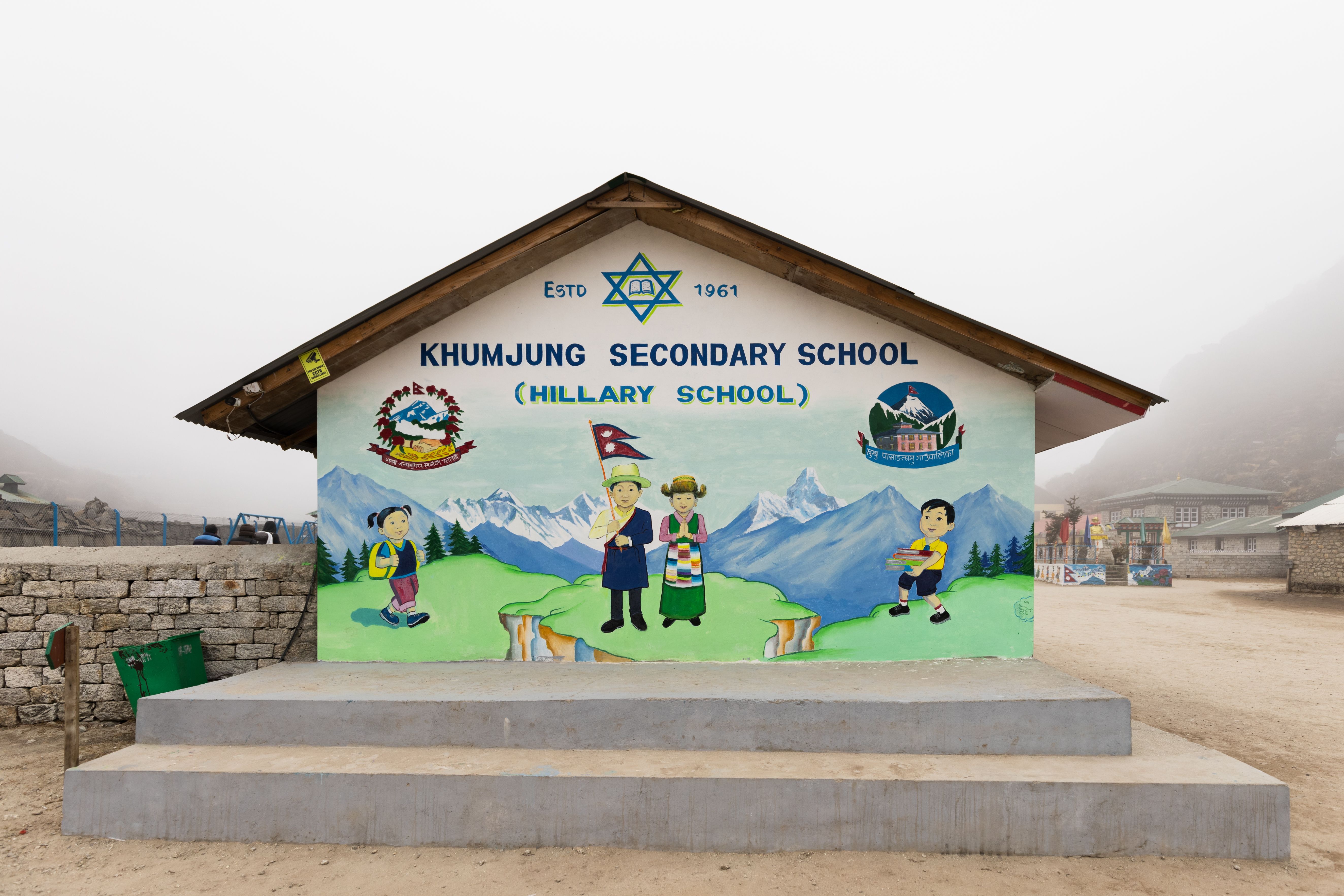
The occasion was the transformation of Sir Ed’s two-room ‘schoolhouse in the clouds’, the very first classroom in the Khumbu built by his own hands with family and friends in 1961. The Himalayan Trust has supported and equipped the Khumjung school ever since. Reimagined as a New Zealand-designed Visitor Centre, the modest tin building’s colourful displays feature the legacy of the Sherpas and the history of Everest.
Last week, the Khumjung Secondary School, also known as the Hillary School, became the the top-performing school in Solukhumbu district, achieving a 100% pass rate with exceptionally high personal scores in the National Examination Board (NEB) results for the 2024 Secondary Education Examination (SEE).
Khumjung’s 27 students, comprising 15 girls and 12 boys, had two pupils scoring A+, 12 scoring A, 11 scoring B+, and two scoring a B. Khamsu Wongdu Sherpa’s A+ score of 3.9 Grade Point Average (GPA) was the highest for a boy in the district. Much credit for these spectacular results goes to the former Headmaster Ngawang Dorjee Rai, and the new incumbent, Kancha Nuru Sherpa and his team.
Solukhumbu topped the 14 districts of Koshi Province with a pass rate of 87%. What makes this particularly remarkable is that, unlike other community schools of Nepal, the students of Khumbu Pasanglhamu Rural Municipality take the exams in English, as introduced by the Himalayan Trust throughout the Khumbu region in 2011.
Alexander Hillary, grandson of Sir Ed who runs Himalayan Trust in New Zealand, says: ‘We are very proud of our exemplary Quality Educational Programme, which is supported by the New Zealand Ministry of Foreign Affairs and Trade. We aspire for the best, we listen to what is needed, we discuss with local leaders, and we rigorously monitor and evaluate in order to get the best results.’
He adds, ‘Supporting 108 schools in five rural municipalities of Solukhumbu, we supply resources and equipment – having the right tools to learn remains a huge challenge because of difficult and expensive transportation, and the cost of buying stationery for families that earn very little. We also provide training and salary support for teachers, upgrade furniture and libraries, and grant scholarships to help young people from the mountain villages pursue higher studies.’
It seems to be working. In Chaurikharka below Lukla, the Mahendra Jyoti Secondary School came second after Khumjung, also taking the SEE exams in English. Of their 52 pupils, 12 passed with an A grade, 36 with B+, and four with B.
Deputy Mayor Tashi Lhamu Sherpa says: ‘We are so pleased with these overall results. High standards of education give our people options for their future.’
Rt Hon Helen Clark contributes: “As Patron of Himalayan Trust NZ, I am so impressed by the wonderful results in national examinations by Solukhumbu students. I am pleased that the Himalayan Trust has long supported schools in the region so that young people can develop to their full potential.”
High tech has reached the high valleys. With the support of the inspirational New Zealand based EduTech Nepal, 43 computer labs have been established in Solukhumbu schools, integrating technology with teaching and learning. Founder Mike Chisholm writes: ‘The EduTech mission is to transform education with technology. We are thrilled with the recent SEE results, particularly the encouraging marks for ICT and computer courses.’
‘Khumbu Pasanglhamu Rural Municipality schools can easily match the standard of Kathmandu-based private and government schools with their overall achievements,’ confirms Pasang Dawa Sherpa, Chairman of Himalayan Trust Nepal. ‘We are delighted that Sir Ed’s humble beginnings have reached such impressive heights.’
It would have been the great grandfathers of today’s high-achieving Khumjung students who had answered Sir Ed’s request of what he could do to help the Sherpas: ‘Our children have eyes but they cannot see. We would like you to open their eyes by building a school in our village.’
Dr Mingma Norbu Sherpa CEO of Himalayan Trust Nepal says: ‘We congratulate the successful students of Khumjung and Chaurikharka. Over the decades, Himalayan Trust has built 42 schools in Solukhumbu, including those in Kharikhola, Nunthala, Junbesi, Loding, Bhakanje, and Thame. We also supported the establishment of Solukhumbu Multiple Campus’
The Himalayan Trust is the Nepali NGO that implements these projects, navigating within the national school system. Although aware of its limitations, flaws and curriculum controversies, today the accomplishments of Solukhumbu students are being recognised whilst hoping for reform and future improvements.
Nepal’s first female warden conservation officer manages Sagarmatha National Park. From her headquarters above Namche, Sushma Rana Magar says: ‘These Solukhumbu schools are doing so well. I hope pupils will study conservation and I request parents to support their children. I would love to see more Sherpas becoming wardens and district forest officers in the future.’
In a very different world today, education has given Sherpas the options and confidence to lead in many fields, well beyond mountaineering and trekking. Sherpas have taken their place amongst the professional elite, as teachers, nurses, doctors, dentists, physiotherapists, hoteliers, engineers, scientists, singers, professors and pilots, and they serve as government ministers, ambassadors, honorary consuls and political leaders. Sherpas own airlines, operator helicopters and fly Boeings.
Sir Ed’s son Peter Hillary has the final word. ‘My father’s vision was to deliver a strong education programme to the Everest region of Nepal and secure a brighter future for as many children and young people as possible. I think he would be immensely pleased with this result, as are we.’